How to Specify a Refuse Chute for New-Build HRBs (High-Risk Buildings)
Essential Guidance for Building Safety Managers, Developers, and Specifiers
When designing a new residential high-rise development, refuse disposal systems may not be the most glamorous element – but they are critical. Getting the specification right is essential for long-term safety, hygiene, regulatory compliance, and resident satisfaction.
A properly specified refuse chute system ensures waste is safely conveyed from upper floors to a central collection point, with minimal disruption, reduced manual handling, fewer odours, and enhanced fire safety. In contrast, poor specification can lead to costly retrofits, non-compliance, and persistent resident complaints.
Given that Building Safety Regulator (BSR) approval is mandatory for works in High-Risk Buildings (HRBs), the refuse chute system must be proven to resist fire and smoke ingress. Smoke remains the primary life-safety risk in these buildings, yet many chute systems are inadequately tested for smoke tightness.
Equally, contractors must now demonstrate third-party accredited competency – experience alone no longer suffices.
Below is essential guidance to help you specify a compliant, robust refuse chute system for your new-build project.
—
1. Understand the Fire Safety Requirements
Since the Grenfell tragedy, fire safety in high-rise buildings is under intense scrutiny. Under the Building Safety Act 2022 , the responsibility lies with developers and owners to ensure safety by design.
Key Fire-Safety Features to Specify:
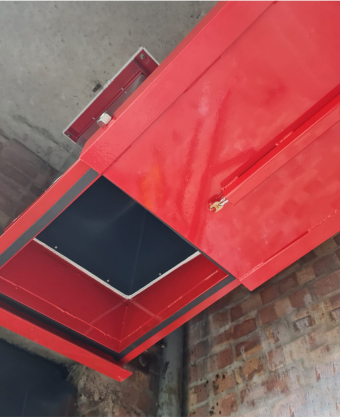
- Fire-rated hopper doors: Must be durable enough to withstand heavy communal use without compromising fire resistance. Look for signs of robustness – fully seam welded steel is usually more durable than folded steel held together with pop rivets. If a door becomes bent out of shape through use, it is no longer compliant and must be replaced. Fit robust doors to avoid this issue.
- Cold smoke seals AND intumescent seals: These must be fitted to all hopper doors to prevent smoke ingress in the event of fire.
- Relevant fire test standards (in the absence of specific chute testing standards, refer to the following, as prescribed by BRE ):
- BS 476 Part 20 & 22:1987 – Structural integrity under fire
- BS 476 Part 31.1 and BS EN 13501-2:2007 + A1:2009 – Smoke tightness / leakage⚠️ Always request certification from the manufacturer confirming compliance with these standards.
- Fire Closure Plates (FCPs): Automatically closing FCPs at the base of each chute must be impact-resistant. HVAC dampers are not suitable – these are designed for airflow, not falling solids. ➤ Refer to BS 1703 – Refuse Chutes and Hoppers, Section 5.1.2: Closure plates should be 6mm thick to resist debris impact.
—
2. Plan for Access and Maintenance
Refuse chutes are not “fit and forget” systems – they require routine servicing and inspection. Maintenance ensures continued compliance and safety, particularly of fire- and smoke-resistant components.
Design should allow safe access to:
- Hopper doors on each floor for resident use
- Secure access doors (non-resident) for blockages and inspections
- FCPs and waste recycling units for routine testing and maintenance – without scaffolding or specialist access equipment
—
3. Size the System Correctly
Incorrectly specified chutes lead to frequent blockages and higher maintenance.
- A 600mm diameter chute is recommended as a standard for new-builds
- Allow for 900mm floor penetration at each level for ease of access and installation
In very tall buildings:
- Use deceleration bends to reduce refuse impact speed – must be constructed of minimum 3mm stainless steel
- Ensure bends are accessible so they can be maintained or replaced. Install hatches above and below allowing for access for unblocking.
- Guidance on household waste can be found in BS 5906:2005 – Waste Management in buildings- Code Of practice
—
4. Plan for Recycling and Future Waste Regulations
From March 31st, 2026, food waste recycling will be mandatory across all English households. Systems must accommodate this shift.
Consider:
- Can the building accommodate multiple dedicated chutes (general, recycling, food)? This is the simplest and lowest-maintenance option.
- If limited to one chute, consider an automated chute recycling unit – but confirm:
- Has the deflector been tested for impact resistance (especially in tall buildings)?
- Can the motor/actuator handle the mechanical strain and weight of frequent usage and accumulation of waste deposits between services?
- Can I obtain feedback from a building owner with the equipment I intend to specify? (if you can… DO!)
- Failure to consider these questions may lead to expensive ongoing running costs, repairs and breakdown time.
—
5. Address Acoustic and Odour Control
Noise and odour are the top causes of resident complaints in poorly specified chute systems.
Your specification should include:
- Fire-resistant acoustic lagging around the chute
- Pre-coated acoustic sections save install time but may offer inferior noise reduction
- Soft-close gas dampers on hopper doors to reduce slamming
- Ensure the soft close mechanism does not compromise the fire integrity of the hopper – confirm no modifications (e.g. drilling) have damaged the hopper, nullifying its fire and smoke testing.
- Self-closing hopper doors are a compliance requirement, but also prevent odour ingress into common areas
- Ventilation/extraction at roof level allows odour to escape, as well as smoke and heat in fire conditions.
- Avoid automated chute cleaning systems – they are ineffective. Instead, schedule regular cleaning using specialist contractors:
- Use high-pressure steam and detergent to remove food waste, grease, and protein build-up, which may also serve as fuel (combustion loading) in fire scenarios
—
6. Work with a Specialist Supplier
Refuse chutes are safety-critical infrastructure. Partnering with an experienced, third-party-certified manufacturer and installer ensures:
- Design compliance with fire, smoke, hygiene, and safety standards
- Support with drawings, BIM files, and technical documentation
- Avoidance of costly specification or installation errors
Hydro Chute works with developers, architects, and contractors to deliver fully compliant, robust chute systems across residential, hotel, and healthcare sectors. For advice or a bespoke specification review, please get in touch.